What Can I Do to My Baby Running a Fever
All kids get a fever from time to time. A fever itself usually causes no harm and can actually be a good thing — it'due south often a sign that the body is fighting an infection.
Merely when your child wakes in the middle of the night flushed, hot, and sweaty, it's easy to be unsure of what to practise next. Should you exit the thermometer? Phone call the doctor?
Hither's more about fevers, including when to contact your medico.
What Is a Fever?
Fever happens when the body's internal "thermostat" raises the body temperature higher up its normal level. This thermostat is found in a part of the encephalon called the hypothalamus. The hypothalamus knows what temperature your body should be (usually around 98.6°F/37°C) and volition send messages to your body to keep it that way.
Most people's body temperatures change a little bit during the course of the solar day: It's usually a little lower in the morning and a little college in the evening and tin can vary every bit kids run around, play, and exercise.
Sometimes, though, the hypothalamus will "reset" the body to a college temperature in response to an infection, illness, or some other crusade. Why? Researchers believe that turning up the rut is a way for the body to fight the germs that cause infections, making information technology a less comfortable place for them.
What Causes Fevers?
It's important to retrieve that fever by itself is non an illness — it's ordinarily a sign or symptom of some other problem.
Fevers tin be acquired by a few things, including:
Infection: Nearly fevers are caused past infection or other illness. A fever helps the body fight infections by stimulating natural defense mechanisms.
Overdressing: Infants, particularly newborns, may become fevers if they're overbundled or in a hot environment because they don't regulate their trunk temperature as well as older kids. Only because fevers in newborns can indicate a serious infection, even infants who are overdressed must be checked by a doctor if they have a fever.
Immunizations: Babies and kids sometimes go a low-form fever later getting vaccinated.
Although teething may crusade a slight rising in body temperature, it's probably not the cause if a child's temperature is college than 100°F (37.8°C).
When Is a Fever a Sign of Something Serious?
In healthy kids, not all fevers demand to be treated. High fever, though, can make a kid uncomfortable and make problems (such as aridity) worse.
Doctors decide on whether to treat a fever by because both the temperature and a kid's overall condition.
Kids whose temperatures are lower than 102°F (38.nine°C) oft don't need medicine unless they're uncomfortable. At that place'south one important exception: If an infant 3 months or younger has a rectal temperature of 100.4°F (38°C) or higher, phone call your doctor or get to the emergency department immediately. Fifty-fifty a slight fever can exist a sign of a potentially serious infection in very young babies.
If your child is between 3 months and 3 years old and has a fever of 102.ii°F (39°C) or higher, phone call to see if your physician needs to see your child. For older kids, take behavior and activity level into account. Watching how your child behaves will give y'all a pretty good idea of whether a pocket-size illness is the crusade or if your kid should be seen by a doctor.
The affliction is probably not serious if your kid:
- is even so interested in playing
- is eating and drinking well
- is alert and smiling at you
- has a normal skin colour
- looks well when his or her temperature comes down
And don't worry too much about a child with a fever who doesn't desire to swallow. This is very mutual with infections that cause fever. For kids who still drink and urinate (pee) usually, not eating equally much as usual is OK.
Is it a Fever?
A gentle osculation on the forehead or a mitt placed lightly on the pare is oftentimes plenty to give you a hint that your child has a fever. However, this method of taking a temperature (called tactile temperature) won't give an accurate measurement.
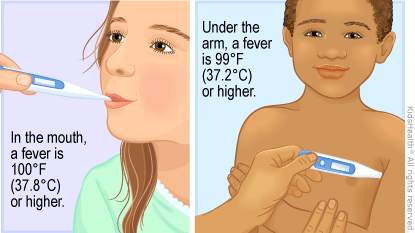
Use a reliable digital thermometer to ostend a fever. Information technology's a fever when a kid'due south temperature is at or above ane of these levels:
- measured orally (in the rima oris): 100°F (37.8°C)
- measured rectally (in the lesser): 100.4°F (38°C)
- measured in an axillary position (under the arm): 99°F (37.2°C)
But how loftier a fever is doesn't tell yous much near how sick your child is. A simple cold or other viral infection can sometimes cause a rather high fever (in the 102°–104°F/38.nine°–40°C range), but this doesn't unremarkably mean there'due south a serious problem. In fact, a serious infection, particularly in infants, might cause no fever or even a low body temperature (below 97°F or 36.i°C).
Because fevers tin can rise and fall, a child might have chills as the trunk'southward temperature begins to rise. The child may sweat to release actress heat as the temperature starts to drop.
Sometimes kids with a fever breathe faster than usual and may accept a faster centre rate. Call the doctor if your child has trouble breathing, is breathing faster than normal, or is nevertheless breathing fast later the fever comes downwards.
p
How Tin can I Help My Child Feel Better?
Again, not all fevers need to be treated. In well-nigh cases, a fever should be treated only if it's causing a child discomfort.
Here are ways to ease symptoms that often accompany a fever:
Medicines
If your child is fussy or uncomfortable, you tin give acetaminophen or ibuprofen based on the parcel recommendations for historic period or weight. (Unless instructed past a doctor, never give aspirin to a child due to its association with Reye syndrome, a rare but potentially fatal disease.) If you don't know the recommended dose or your kid is younger than ii years one-time, telephone call the physician to find out how much to requite.
Infants younger than 2 months old should not be given whatsoever medicine for fever without being checked by a doctor. If your child has any medical problems, cheque with the doctor to see which medicine is all-time to apply. Retrieve that fever medicine tin can temporarily bring a temperature down, just usually won't return it to normal — and information technology won't treat the underlying reason for the fever.
Domicile Condolement Measures
Dress your child in lightweight clothing and cover with a light sheet or blanket. Overdressing and overbundling tin can prevent body heat from escaping and can crusade the temperature to rise.
Brand sure your child'southward bedroom is a comfortable temperature — not too hot or too common cold.
While some parents employ lukewarm sponge baths to lower fever, this method only helps temporarily, if at all. In fact, sponge baths tin can brand kids uncomfortable. Never use rubbing alcohol (it tin cause poisoning when absorbed through the pare) or ice packs/cold baths (they can cause chills that can heighten body temperature).
Food and Drinks
Offer plenty of fluids to avoid dehydration because fevers brand kids lose fluids more than speedily than usual. H2o, soup, ice pops, and flavored gelatin are all good choices. Avoid drinks with caffeine, including colas and tea, considering they tin can make aridity worse by increasing urination (peeing).
If your kid besides is vomiting and/or has diarrhea, inquire the dr. if yous should requite an electrolyte (rehydration) solution fabricated especially for kids. Y'all can find these at drugstores and supermarkets. Don't offer sports drinks — they're not fabricated for younger children and the added sugars can make diarrhea worse. Too, limit your child'due south intake of fruits and apple juice.
In general, allow kids eat what they want (in reasonable amounts), but don't force it if they don't feel like it.
Taking it Piece of cake
Make certain your child gets plenty of residuum. Staying in bed all day isn't necessary, but a sick child should accept it easy.
It'southward best to proceed a child with a fever dwelling house from school or childcare. Most doctors feel that it'due south safe to render when the temperature has been normal for 24 hours.
When Should I Call the Medico?
The verbal temperature that should trigger a telephone call to the doctor depends on a child'south age, the affliction, and whether there are other symptoms with the fever.
Call your medico if yous have an:
- infant younger than 3 months one-time with a rectal temperature of 100.4°F (38°C) or higher
- older child with a temperature of college than 102.2°F (39°C)
Likewise phone call if an older kid has a fever of lower than 102.two°F (39°C) but as well:
- refuses fluids or seems too ill to drink adequately
- has lasting diarrhea or repeated vomiting
- has whatsoever signs of aridity (peeing less than usual, not having tears when crying, less alert and less active than usual)
- has a specific complaint (like a sore throat or earache)
- still has a fever after 24 hours (in kids younger than 2 years erstwhile) or 72 hours (in kids 2 years or older)
- is getting fevers a lot, even if they only terminal a few hours each dark
- has a chronic medical problem, such as heart illness, cancer, lupus, or sickle cell disease
- has a rash
- has pain while peeing
Go emergency care if your child shows any of these signs:
- crying that won't end
- extreme irritability or fussiness
- sluggishness and trouble waking upwardly
- a rash or purple spots that look similar bruises on the skin (that were not there earlier your kid got sick)
- blue lips, tongue, or nails
- babe's soft spot on the head seems to be bulging out or sunken in
- stiff cervix
- severe headache
- limpness or refusal to move
- problem animate that doesn't get better when the nose is cleared
- leaning forrad and drooling
- seizure
- moderate to astringent belly pain
Also, ask if your md has specific guidelines on when to phone call about a fever.
What Else Should I Know?
All kids get fevers, and in most cases they're completely back to normal inside a few days. For older babies and kids, the style they act can be more important than the reading on your thermometer. Everyone gets a little cranky when they have a fever. This is normal and should exist expected.
But if y'all're ever in doubt nearly what to practise or what a fever might mean, or if your kid is acting sick in a fashion that concerns yous even if there'south no fever, always telephone call your dr. for advice.
Source: https://kidshealth.org/en/parents/fever.html
0 Response to "What Can I Do to My Baby Running a Fever"
Postar um comentário